
AI boom or inequality trap? Women warn Pax Silica must not leave communities behind on NewsLine Philippines - Building Information Highway for the Community
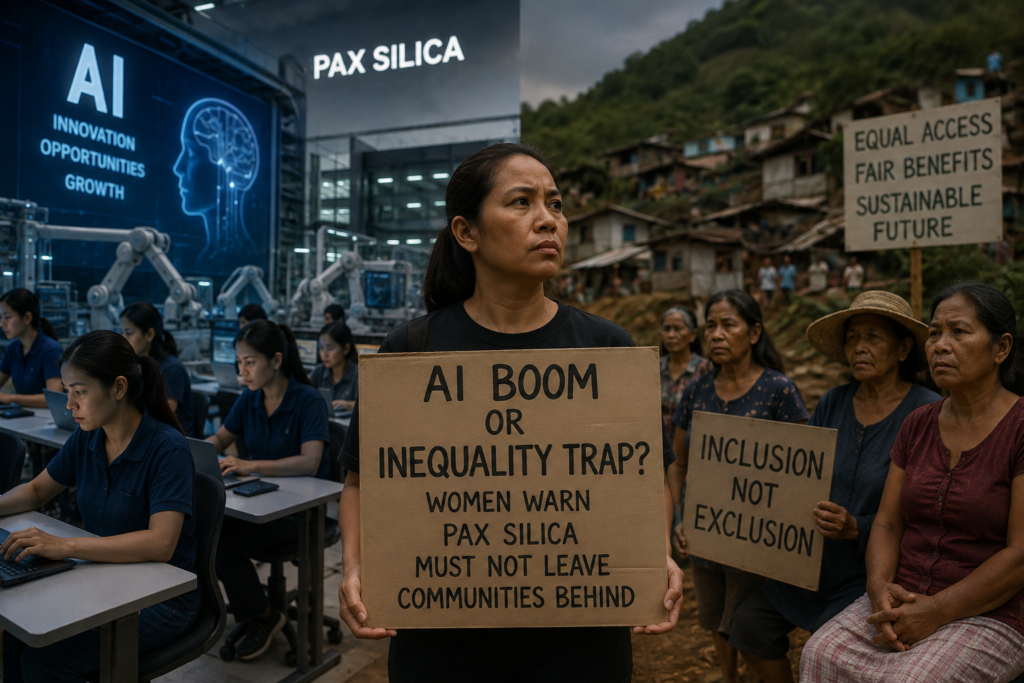
MANILA (August 1) — The Philippines wants to become an artificial intelligence powerhouse. But as the country courts billions of dollars in AI, semiconductor and critical-mineral investments, women advocates are asking a question that could matter more to ordinary communities than the size of the deals:
Who benefits—and who pays the price?
That question is gaining urgency with the US-led Pax Silica initiative, which seeks to position the Philippines as a strategic hub for critical minerals, semiconductor manufacturing and energy infrastructure.
President Ferdinand Marcos Jr. has touted the initiative as a way to create quality jobs, strengthen industrial competitiveness and revive the economy. Proponents say it could attract as much as US$100 billion in private investment.
But advocates warn that investment figures alone do not make development successful.
Without climate justice, gender equity and meaningful community participation built into the initiative from the start, they say, Pax Silica could repeat an old pattern: economic gains are concentrated while environmental and social costs are pushed onto communities least able to absorb them.
The power problem behind AI
AI may be digital, but its infrastructure is intensely physical.
Data centres, semiconductor plants and advanced manufacturing facilities require huge amounts of reliable electricity. If clean energy and grid capacity do not keep pace, the country could lock itself deeper into fossil-fuel dependence.
A single hyperscale data centre can consume as much electricity as a mid-sized city, said Isabella Suarez, head of engagement for Southeast Asia at climate tech nonprofit TransitionZero.
That makes the AI push an energy question for households, too.
If industrial demand drives up pressure on the grid and electricity costs, will ordinary consumers end up subsidising the country’s AI ambitions?
“Large industrial electricity consumers can reshape pricing dynamics for ordinary households if grid expansion and cost recovery aren’t structured carefully,” Suarez said.
A transition that delivers industrial growth while raising energy costs for ordinary families, she added, cannot be considered a success.
There is an opportunity to avoid that outcome. Authorities have said a Saudi firm plans to develop a 500-megawatt solar farm in New Clark City, while Japanese and South Korean companies have expressed interest in clean-energy projects tied to the Pax Silica hub.
But experts warn that renewable energy must be planned alongside industrial expansion—not after it.
Who gets the jobs?
Pax Silica could help the Philippines move beyond lower-value activities such as assembly and packaging into higher-value technology industries.
But the promised jobs will not automatically benefit local workers.
Women remain seriously underrepresented in the region’s energy and technology sectors. They account for only about 8 percent of the Asean energy workforce, fewer than one in five leadership positions, and 19.3 percent of STEM graduates across Southeast Asia.
That makes training and access to higher-skilled employment critical.
Hannah Chan, senior lawyer for Resources, Energy and Mobility in Japan and Southeast Asia at environmental law charity ClientEarth, said the government must plan for workers who could be displaced by the industrial shift.
That means upskilling and reskilling, job placement, social safety nets and access to education and health assistance.
Otherwise, communities could provide the land and resources for the new economy without being equipped to participate in it.
Development at whose expense?
The risks extend beyond jobs and electricity.
Rapid industrialisation could intensify pressure on land, water and power systems, while critical-mineral mining could threaten biodiversity and ancestral lands.
Chan warned against judging projects only by their short-term economic gains.
Mining transition minerals in nearby provinces, for example, could destroy biodiversity and ancestral territories while increasing future risks such as landslides and flooding—costs that communities and future generations may ultimately carry.
That is why advocates say consultation must begin before major decisions are already settled.
“Communities shouldn’t enter the process at the consultation stage because by then the substantive decisions have usually already been made,” Suarez said.
For indigenous communities and local governments, participation should mean more than being informed about projects already negotiated.
They should have a voice in shaping the terms.
The fine print matters
The Philippines already has mechanisms, including the Renewable Energy Act and the Green Energy Option Programme, that could help steer new AI infrastructure toward renewable electricity.
Authorities could also require data centres and advanced manufacturing facilities in economic zones to incorporate renewable generation and battery storage into their designs.
But the ultimate test of Pax Silica will not be the number of investment pledges announced.
It will be the conditions attached to them.
“The central question isn’t whether the Philippines participates in initiatives, it’s what conditions it negotiates,” Suarez said.
For communities, that means asking questions that can easily get buried beneath billion-dollar investment figures:
How much land and water will projects consume? Who pays for new power infrastructure? Will electricity costs rise? How many local workers will get the high-skilled jobs? What happens to displaced communities? Were indigenous peoples and local governments genuinely involved in negotiations? And are environmental and social safeguards legally enforceable?
Pax Silica could help build a cleaner, higher-skilled and more competitive Philippine economy.
But without safeguards, it could just as easily deepen the inequalities that development is supposed to solve.
The AI race may be global. Its costs—and its benefits—will be felt in local communities.
The post AI boom or inequality trap? Women warn Pax Silica must not leave communities behind appeared first on NewsLine Philippines.
AI boom or inequality trap? Women warn Pax Silica must not leave communities behind
Newspaper Updates PH
0 comentários :
Post a Comment